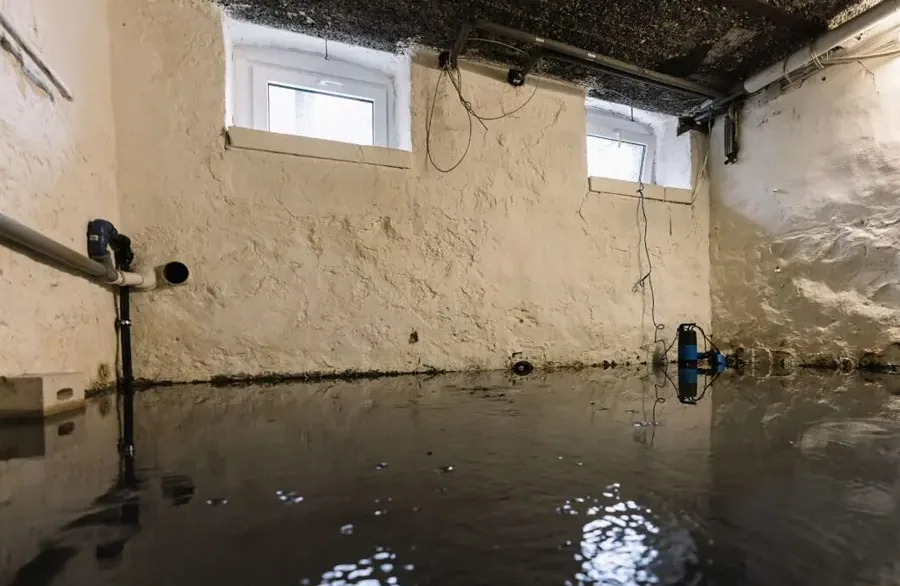
Hopkins sits between two creeks, and a basement can take on water from either one, or from heavy rain that has nowhere to go. Knowing which source is at work shapes the first hour and the cleanup that follows.
Key takeaways
- Minnehaha Creek runs across the north end of the city and down the east side, and the north fork of Nine Mile Creek starts at the south edge of Excelsior Boulevard in the southwest.
- Both creeks are mapped flooding sources, and several land-locked low areas have no natural surface outlet for rain.
- Stay out of a flooded basement until the power to it is confirmed off, because standing water and live circuits are the first hazard.
- Creek and storm water are handled as Category 3, so soaked carpet, pad and similar porous finishes are removed rather than dried.
- Photos and notes taken before anything is moved give the dry-out a record of what was wet and where.
Where basement water comes from in Hopkins
Three sources matter most here, and each behaves differently. One rises slowly over days, one can jump during a single storm, and one is rain trapped on a low lot.
Minnehaha Creek on the north and east sides
Minnehaha Creek crosses the north end of the city and runs down the east side past Cottageville Park and Blake Road.
After a long wet stretch the creek can spill over its banks and soak yards, window wells and low basement floors nearby.
The north fork of Nine Mile Creek
The north fork of Nine Mile Creek starts at the south edge of Excelsior Boulevard in southwest Hopkins.
Near the head of a creek, water can climb quickly when a storm drops rain on pavement and roofs all at once.
Land-locked low areas
Several low areas in the city have no natural surface outlet. Rain that lands there cannot run off, so it pools on lawns and driveways and presses toward the foundation.
Telling creek water from a plumbing leak
A pipe leak and a flood can look alike on a basement floor, but the clues differ.
When the source is unclear, the safe move is to treat the water as contaminated until a crew has checked it.
- Water that shows up after rain or a thaw, and not on a dry day, points to the outside.
- Silt, grit or a sour smell suggests creek or storm water, not a clean supply pipe.
- Water entering at the joint where wall meets floor, or through a window well, points to groundwater or surface flow.
- Water rising from a floor drain points to a sewer backup, which is handled as sewage. See sewage backup cleanup for that case.
The first hour in a flooded basement
Safety steps
Safety comes before saving belongings. Water, electricity and stairs make a poor mix.
- If the electrical panel sits in or near the water, stay out and call the electric utility.
- Where the panel is dry, switch off the basement circuits before stepping into any standing water.
- Keep children and pets away from the water.
- Photograph the water mark on the walls and the items on the floor before anything is moved.
- Lift papers, small electronics and boxes to a dry shelf, and leave heavy furniture for the crew.
- Skip the household vacuum; it is not made for standing water.
If the water is still rising
Water outside the house can keep rising for hours after the rain stops, especially close to a creek.
Pumping a basement down too fast while the ground outside is saturated can stress walls and floors, so the crew paces extraction to the conditions outside.
- Do not open basement doors or windows to let the water out.
- Watch the level against a fixed mark, such as a stair tread, and note the time.
- Keep people out of the area until the level has stopped rising.
- Move vehicles and stored items out of a low garage if the yard is filling.
What the restoration team does with creek and storm water
Pump out, then take out what soaked
The crew starts with water extraction, because water left standing keeps wicking higher into drywall and wood.
Creek and storm water carry soil and bacteria, so they are handled as Category 3. Carpet, pad, low drywall and insulation that soaked it up are cut out and bagged instead of being dried.
Dry what stays
Framing, subfloor and the slab stay in place and go through structural drying. Fans and dehumidifiers work together while a moisture meter shows which spots are still wet.
Readings are logged each day, and the equipment leaves only when the structure reaches the dry standard.
What stays wet after the surface is dry
A floor that looks dry is not a dry basement. Water hides where eyes and hands do not reach.
A meter pressed against the wall and a thermal image of the surface show where moisture is still trapped.
Skipping this step is how a basement that seemed fine in week one ends up with a musty smell and warped trim in week three. The readings, not the look of the surface, decide when drying ends.
- Behind baseboards and paneling.
- Inside wall cavities and insulation.
- Under flooring and in the subfloor.
- In the bottom plate of walls, where framing meets the slab.
- Inside stored boxes and the backs of furniture.

How past storms show the range
Water levels in this part of Minnesota swing widely. On July 23 and 24, 1987, a superstorm dropped more than 10 inches of rain on suburbs west and southwest of Minneapolis.
That was a regional event, not a record kept for one street.
In June 2014, Minnehaha Creek set a record flow of 889 cubic feet per second during a season of high water across the area.
Those events are not a forecast. They are a reminder that a creek that looks calm in August can behave very differently after a wet spring.
When to call for help
Standing water in a basement is a job for a crew with pumps, not a mop. An early call lets the team learn whether the water is creek water, storm water or something else, and plan for it.
The restoration team handles basement flooding cleanup from the first pump-out to the final readings, and storm and creek flood cleanup when the water came from outside.
Questions
Is creek water in a basement treated differently from a burst pipe?
Yes. A burst supply pipe releases clean water, while creek and storm water carry soil and bacteria and are handled as Category 3. That changes what is removed and how the area is cleaned.
Can carpet be saved after creek water?
Usually not. Category 3 water soaks into carpet and pad, and those materials are removed. Concrete and other hard surfaces can be cleaned, disinfected and dried.
Are homes beside the creeks the only ones at risk?
No. Low lots with no natural outlet can collect rain, and a failed sump pump or a backed up sewer can flood a basement far from either creek.
Should the sump pump keep running during a flood?
A working pump helps, but it cannot keep up when outside water rises fast. If the pump stops or the pit overflows, extraction by a crew is the next step.
How long does a flooded basement take to dry?
It depends on how much water came in, how long it sat and what the walls are made of. The drying time estimator gives a rough range, and moisture readings give the real answer.
Does creek water always mean the whole basement is gutted?
No. It depends on how deep the water got and what the materials are. Often only the lower part of the walls and the floor coverings go, while framing and concrete are cleaned and dried.