Structural Drying and Dehumidification in Hopkins, MN
Surfaces can feel dry while studs, subfloor and the slab still hold water. The drying team measures the structure, sizes the equipment to the class of loss and keeps it running until readings match a dry reference.
(888) 432-4933Get the structure dried right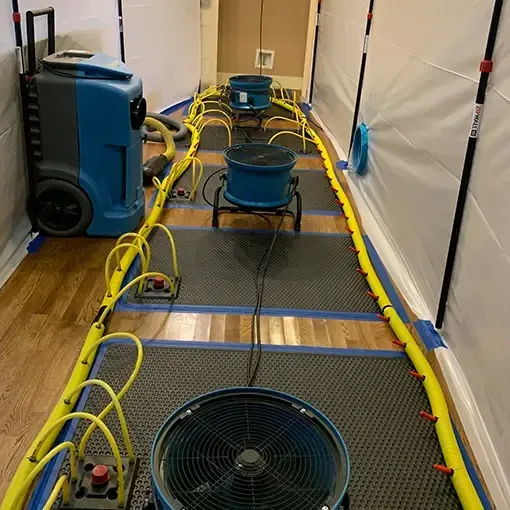
Structural drying is the part of a water job nobody sees: getting the water out of framing, subfloor, wall cavities and concrete, not just off the surface. It is measured, not guessed.
What to do first for structural drying and dehumidification
- 1
Keep the equipment running
Turning it off at night lets moisture settle back into materials.
- 2
Keep doors and windows closed
Unless the drying team says otherwise; it keeps the drying chamber working.
- 3
Leave openings alone
Vent holes and removed baseboards are part of the airflow plan.
- 4
Note any new stains
Tell the drying team if a stain grows or a smell appears.
What does structural drying and dehumidification cost in Hopkins, MN?
In Hopkins, structural drying and dehumidification typically runs $1,200 to $8,000, depending on the class of loss, how many rooms need equipment, the materials involved and how many days it takes to reach the goal.
Class 1 or 2, one area
$1,200 to $3,000- Air movers
- LGR dehumidifier
- Daily readings
Class 3, several rooms
$3,000 to $5,500- Multiple dehumidifiers
- Cavity drying
- Psychrometric logs
Class 4, hardwood or plaster
$5,500 to $8,000- Desiccant dehumidifier
- Drying mats
- Extended monitoring
These are typical figures, not a quote. Water category, wet square footage, material class and how quickly drying began move the total the most. The water damage cost calculator gives a closer range for your rooms.
How structural drying and dehumidification is done, start to finish
Moisture gets mapped before a single fan is placed, so the plan follows what is actually wet. The drying team leaves the equipment running until meter readings reach the goal, whatever the surface looks like.
- 1
Map and classify
Meters and thermal imaging set the wet area and the class of loss.
- 2
Set the chamber
Rooms are closed and equipment sized to the evaporation load.
- 3
Monitor daily
Readings and psychrometric logs guide equipment changes.
- 4
Confirm dry
Equipment leaves when materials reach the dry reference goal.
Class of loss sets the equipment
IICRC S500 groups losses by how much water the materials absorbed. Class 1 is a small area with little absorption; Class 2 a whole room with wet carpet and lower walls; Class 3 ceilings, walls and floors soaked; Class 4 dense materials such as hardwood, plaster and concrete that hold water tightly.
- Air movers placed to match each room's evaporation load.
- LGR dehumidifiers for most losses; desiccant units for Class 4 and cold spaces.
- Drying mats for hardwood floors that would otherwise cup.
Drying in a Minnesota basement or winter house
Basements stay cool, and cool air holds less water, so basement drying runs slower without the right dehumidification. In winter, heated indoor air is dry and helps evaporation, while summer humidity works against it. The drying team reads temperature and humidity every day and adjusts heat, airflow and dehumidifiers to keep moisture moving out.
- Wall cavities ventilated with small holes and directed air.
- Plaster walls in older homes dried slowly to avoid cracking.
- Slabs checked with meters before new flooring goes down.
Proof that the structure is dry
A dry reference reading is taken in an unaffected area of the same home. Equipment stays until wet materials sit within 2 to 4 points of it, and the daily psychrometric logs go into the claim file. The EPA moisture guide and the EPA indoor air quality pages explain why leftover moisture matters. Water extraction comes first on every job.
Structural drying and dehumidification around Hopkins and west Hennepin County
The restoration crew works both ZIPs, 55343 and 55305, from Mainstreet and the Avenues out to Interlachen Park, Hobby Acres, Park Valley and the Blake Road side of Minnehaha Creek.
Nearby coverage reaches Minnetonka, Edina, St. Louis Park, Plymouth, Orono.
Other water problems handled here
Structural Drying and Dehumidification questions in Hopkins, MN
Why does drying take several days?
Water has to move out of wood, drywall and concrete at a controlled rate. Forcing it too fast can crack plaster and cup hardwood.
What is a dry reference?
A reading taken on the same material in an unaffected part of the home. Wet materials are dry when they read within 2 to 4 points of it.
Can I turn the dehumidifiers off at night?
It is best not to. Drying is continuous, and stopping lets humidity climb back into the materials.
Why are there holes in my walls?
Small vent holes let dry air into wall cavities so studs and insulation can dry without removing the whole wall.
What is a desiccant dehumidifier?
A unit that pulls moisture with a drying wheel instead of a cold coil. It works well in cool basements and on dense Class 4 materials.
When can repairs start?
After the readings confirm the structure is dry. Closing up damp framing traps moisture inside the wall.
Need the framing dried, not just the surface? Call now.
Hidden moisture in studs and subfloor causes problems long after the carpet feels dry. The drying team measures it out.
(888) 432-4933Dry the structure properly- Active water treated as urgent, 24/7
- Drying goal set by IICRC S500
- Moisture logs kept for the adjuster
- Find us on Google