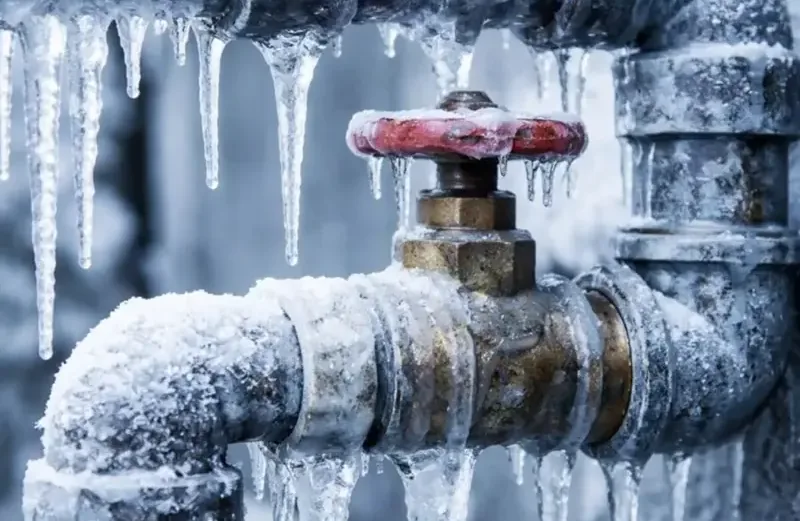
Twin Cities area winters bring subfreezing weather that can freeze and burst pipes. In Shorewood the water supply is not the same at every address: about half of residential properties use city water, and many others rely on private wells.
Key takeaways
- About one half of Shorewood's residential properties are on city water, and many residents rely on private wells.
- The city bills 3,070 properties for city utilities, and 1,608 of them are billed for city water.
- A split pipe is shut off at the main valve inside the house; a home on a well also has a pump and pressure tank to switch off.
- Public Works operates the city's wells, two storage reservoirs and distribution system, while testing a private well is the owner's job.
- Freeze breaks hide in walls, ceilings and unheated spaces, so the water is often found by readings and not by sight.
Two kinds of water supply, one cold snap
A hard freeze treats every pipe the same, but who is responsible for the water supply depends on the address.
City water homes
The city buys water from Chanhassen and also runs its own wells. The Public Works Department on Smithtown Road operates the wells, two storage reservoirs and the distribution system.
Of the 3,070 properties the city bills for utilities, 1,608 are billed for city water. About 400 properties could connect but are not connected.
Private well homes
Many residents rely on private wells. The Minnesota Department of Health tests the community water system each year, but testing a private well is the homeowner's job.
That split matters in a freeze, because a well home has its own pump and pressure tank in the chain.
Before the first hard freeze
Chores to do now
A few quiet chores in the fall cost little compared with water damage restoration after a split pipe in January.
- Find the main shutoff valve and make sure everyone in the house can reach it.
- Disconnect and drain outdoor hoses, and shut off the supply to outdoor spigots where there is a valve.
- Insulate pipes in garages, crawl spaces and exterior walls.
- Open cabinet doors under sinks on outside walls during a deep freeze.
- Let a faucet drip on the coldest nights if a pipe runs through an exposed wall.
- Keep the heat on in an empty house, set well above freezing.
Extra steps for a private well home
A well adds equipment that can freeze or fail in a cold snap.
- Know where the well pump breaker and the pressure tank valve are.
- Check that the space that holds the pressure tank stays above freezing.
- Keep a plumber or well contractor's number where everyone can find it.
Signs a pipe has already frozen
A frozen pipe usually gives a warning before it splits.
- No water, or only a trickle, from a tap on a very cold morning.
- Frost on a pipe in a garage, crawl space or cabinet.
- A wall or ceiling that feels cold and damp, or a new stain beneath an exterior wall.
- A bulge or crack in a visible pipe.
When a pipe splits in a city water home
The first job is to stop the water. Every minute a split pipe runs, more gets into walls, ceilings and floors.
Water coming from the street or the curb outside the house is a matter for the Public Works Department, which operates the city's distribution system.
- Shut off the main valve at the house.
- Open a low faucet to drain what remains in the pipes.
- Turn off power to any wet room if water is near outlets or lights.
- Photograph the damage, then call for water extraction before the water wicks further.
- Have a plumber repair the pipe once the area is safe.
When a pipe splits in a private well home
A well home needs one more step, because the pump keeps pushing water until it is stopped.
- Switch off the well pump at its breaker so it stops pushing water into the broken pipe.
- Close the valve at the pressure tank, or the main valve, if one is reachable and dry.
- Open a low faucet to relieve the pressure left in the system.
- Call a plumber or well contractor to look at the pump and tank, since a freeze can reach them too.
What cleanup looks like after a freeze break
Freeze breaks often happen in places no one looks at: an exterior wall, a ceiling cavity, a cabinet against a cold wall or an unheated utility space. The water can run for hours before anyone sees it.
Find where the water went
The crew follows the water with a moisture meter and a thermal camera, since drywall can look dry on the surface while insulation behind it is soaked.
Remove and dry
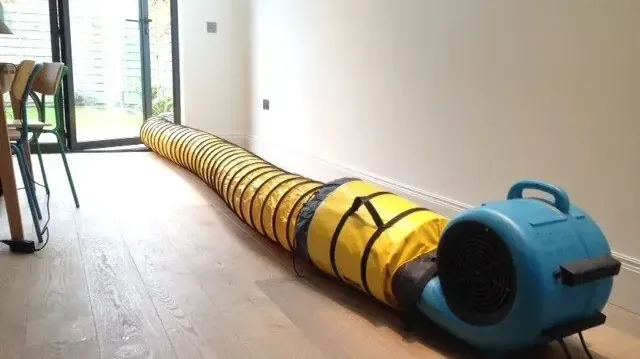
Standing water is pumped out first, and wet insulation and soaked drywall are removed where drying will not work. Frozen pipe cleanup then moves to fans and dehumidifiers, with daily readings until the framing is dry.
When the pipe itself failed, burst pipe water damage work covers the wall and floor repair after the dry-out.
Rebuilding after the dry-out
Once the readings are dry, the opened wall or ceiling is repaired and finished. Rebuilding before then traps moisture behind new drywall and paint, which is why the readings come first.
Discolored water is not always a break
Not every strange tap is a freeze problem. The city flushes its water mains twice a year, in spring and fall, and flushing can cause rusty or discolored water.
That water usually clears after the cold tap runs for a while. Water that stays discolored, or a wet spot that keeps growing, points to a real leak.
Repairs to a water or sewer service connection also carry paperwork: the city has a water and sewer permit application, and inspections need at least 24 hours of notice.
Questions
How many Shorewood properties are on city water?
The city bills 3,070 properties for utilities, and 1,608 of them are billed for city water. Only about one half of residential properties are served, and many residents rely on private wells.
Who tests private well water?
The Minnesota Department of Health tests the community water system each year. Testing a private well is the homeowner's job.
What should be shut off first when a pipe splits?
The main water valve at the house. A well home should also switch off the pump at its breaker so it stops pushing water into the break.
Why is a freeze break hard to find?
The pipe often splits inside a wall, a ceiling or an unheated space, so water runs out of sight. Moisture readings and thermal images trace it.
Does rusty water in spring or fall mean a pipe broke?
Not necessarily. The city flushes its mains twice a year, and flushing can cause rusty or discolored water that clears when the cold tap runs.
What if a pipe freezes but has not burst?
Shut off the water to that pipe if it can be reached, open a nearby tap and warm the area gently with a space heater placed well away from anything that burns. Do not use an open flame. If the pipe has split, treat it as a leak.