Structural Drying Shorewood, MN
Water that has soaked into framing, subfloors and masonry does not leave on its own. The drying team places air movers and dehumidifiers by a calculated plan and logs the readings until each material is dry.
(888) 432-4933Shorewood structural drying help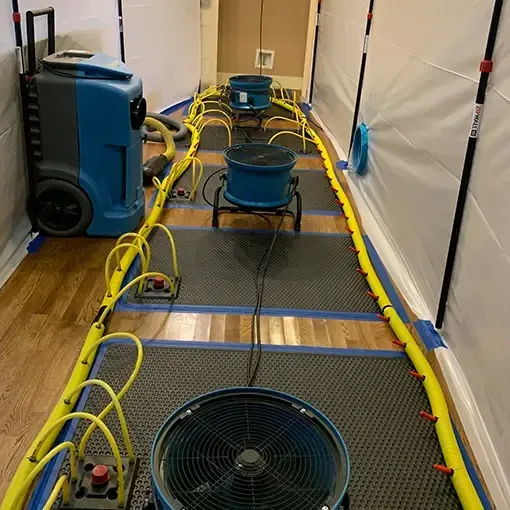
Extraction pulls out the water you can see. Structural drying removes the moisture you cannot, using controlled air, heat and humidity to move it out of wood, plaster, concrete and insulation.
What to do first for structural drying and dehumidification
- 1
Stop the water first
Shut off the source and let extraction finish before drying equipment is set.
- 2
Keep the equipment running
Leave equipment on and keep doors and windows closed to hold the controlled air.
- 3
Do not turn up the heat
Extra heat can push moisture into cavities, so leave the thermostat as set.
- 4
Keep a log
Note start dates, equipment placed and any new stains for the claim file.
What does structural drying and dehumidification cost in Shorewood, MN?
A Class 1 or 2 loss in one area costs $1,200 to $3,000. Class 3 across several rooms runs $3,000 to $5,500, and a Class 4 loss in hardwood or plaster reaches $5,500 to $8,000.
Class 1 or 2, one area
$1,200 to $3,000- Air movers set
- LGR dehumidifier
- Daily readings
Class 3, several rooms
$3,000 to $5,500- Several dehumidifiers
- Cavities dried
- Psychrometric logs
Class 4, hardwood or plaster
$5,500 to $8,000- Desiccant unit
- Drying mats
- Extended monitoring
These are typical figures, not a quote. Water category, wet square footage, material class and how quickly drying began move the total the most. The water damage cost calculator gives a closer range for your rooms.
How structural drying and dehumidification is done, start to finish
Moisture gets mapped before a single fan is placed, so the plan follows what is actually wet. The drying team leaves the equipment running until meter readings reach the goal, whatever the surface looks like.
- 1
Classify the water
The team identifies the water class and materials to size the equipment.
- 2
Set the equipment
Air movers, dehumidifiers and mats go in by calculation.
- 3
Monitor each visit
Meters and psychrometric readings track progress and trigger changes.
- 4
Release at dry
Equipment leaves once every material meets its dry goal on the readings.
Matching the plan to the class
Drying plans follow the water class. A Class 1 or 2 loss in one area needs less equipment than a Class 3 loss through ceilings and walls, and a Class 4 loss in hardwood, plaster or concrete needs specialty equipment and more time.
- Class 1 and 2 losses involve limited absorption.
- Class 3 water, often from a ceiling leak, soaks walls and insulation.
- Class 4 losses involve dense materials that hold moisture deep.
Why readings drive the work
A room that feels dry can still hold water in the studs. Psychrometric readings track temperature, humidity and grains of moisture in the air, while meters track the materials themselves.
- Readings are taken at set points on every visit.
- Equipment is adjusted as materials dry and the air changes.
- The job closes only when each material meets its dry goal.
Drying without tearing out
Many materials dry in place when airflow and humidity are managed well. Drilled holes, panels lifted at the edges and drying mats let air reach cavities without removing drywall or flooring.
With 3,023 housing units in the city, the details differ from house to house, which is why the plan is built from readings and not from guesses.
Structural drying and dehumidification around Shorewood and nearby towns
Structural drying calls are covered across ZIP codes 55331 and 55364, including homes along State Highway 7, Smithtown Road and Country Club Road and the lakeshore streets.
The same service nearby: structural drying and dehumidification in Hopkins, Orono, Minnetonka.
Related water damage services in Shorewood
Structural Drying and Dehumidification questions in Shorewood, MN
How long does structural drying take?
Most jobs run several days, depending on the class, the materials and how much water soaked in. Readings decide the end date.
Why is the equipment so loud?
Air movers and dehumidifiers run steadily to keep air moving across wet surfaces. The noise is temporary and a sign that drying is under way.
Can I turn the equipment off at night?
No. Drying depends on continuous operation, and stopping lets moisture settle back into materials.
Will my power bill rise?
Yes, somewhat, since the equipment draws steady power. Keep your utility bill in the claim file, since adjusters often ask for it.
Does hardwood have to be replaced?
Not always. Specialty mats can dry floors that are caught early, though cupped or buckled boards often cannot be saved.
How is dry confirmed?
Meters compare wet materials with a dry reference reading from the same house, and the final log shows they match.
Dry to the touch is not the same as dry
Moisture left in framing and subfloors causes trouble long after the surface dries. The crew dries by calculation and proves it with readings.
(888) 432-4933Set up the drying plan- Active water treated as urgent, 24/7
- Drying goal set by IICRC S500
- Moisture logs kept for the adjuster
- Find us on Google