Structural Drying Orono, MN
Surface water gone does not mean the building is dry. The drying team in Orono sets air movers and dehumidifiers to a plan, tracks readings and keeps going until framing and floors reach their goal.
(888) 432-4933Orono drying equipment help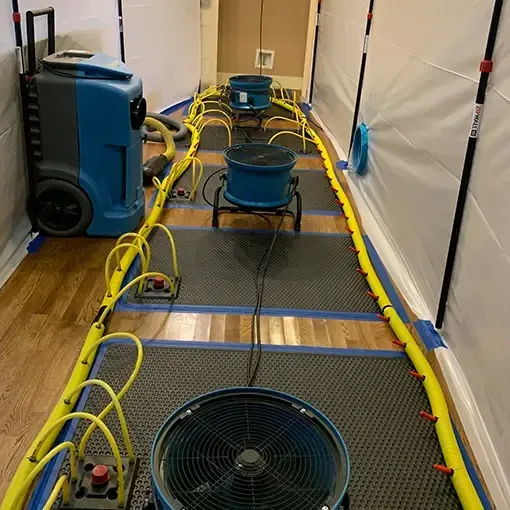
Many lakeshore homes have been extensively remodeled, so one wall can hide old framing, newer drywall and added insulation. Each layer dries at its own pace, and structural drying plans for all of them.
What to do first for structural drying and dehumidification
- 1
Open interior doors
Let air move between rooms and keep the thermostat steady so drying can work.
- 2
Remove loose items
Clear furniture and rugs so air can reach floors and walls.
- 3
Hold off on repairs
Do not repaint, refloor or close walls until readings show dry.
- 4
Save the records
Keep photos and receipts so the drying log matches the claim.
What does structural drying and dehumidification cost in Orono, MN?
Structural drying usually costs $1,200 to $8,000. A Class 1 or 2 loss in one area sits at the low end, while Class 4 materials such as hardwood or plaster need the longest equipment run.
Light loss, one area
$1,200 to $3,000- Air movers placed
- Dehumidifier running
- Daily meter checks
Class 3, several rooms
$3,000 to $5,500- More dehumidifiers
- Cavities dried
- Humidity logs
Class 4, hardwood or plaster
$5,500 to $8,000- Desiccant unit
- Drying mats
- Longer monitoring
These are typical figures, not a quote. Water category, wet square footage, material class and how quickly drying began move the total the most. The water damage cost calculator gives a closer range for your rooms.
How structural drying and dehumidification is done, start to finish
Moisture gets mapped before a single fan is placed, so the plan follows what is actually wet. The drying team leaves the equipment running until meter readings reach the goal, whatever the surface looks like.
- 1
Classify the loss
The team rates the water and materials to set the airflow plan.
- 2
Place the equipment
Air movers and dehumidifiers go where the maps show water.
- 3
Monitor each visit
Meters and psychrometers track moisture, temperature and humidity.
- 4
Remove at the goal
Equipment comes out as each area reaches dry.
How drying is classified
Drying is planned by how much water a building took on. Class 1 and 2 losses involve limited wet material, Class 3 covers ceilings and walls soaked from above, and Class 4 involves dense materials such as hardwood or plaster.
- Class 1 and 2: carpet, pad and lower walls
- Class 3: ceilings, walls and insulation soaked from above
- Class 4: hardwood, plaster and concrete
Equipment that does the work
Air movers push dry air across surfaces, while dehumidifiers remove moisture from the air so it keeps pulling water out of materials. Desiccant units and drying mats handle dense materials and hardwood floors. Standing water is removed first through water extraction.
- LGR dehumidifiers for most rooms
- Desiccant units for cold or dense materials
- Mats and panels for hardwood and subfloor
Why readings decide the end date
Meters and psychrometers record moisture content, temperature and humidity at each visit, and a log shows the trend toward the dry goal. Equipment is pulled as each area reaches it, not on a calendar.
The housing plan, written for 2008 to 2030, counted about 44% of homes as more than 50 years old, so a drying plan has to be built around what is actually inside each wall. That matters most after basement flooding, where lower walls take the most water.
Structural drying and dehumidification around Orono and nearby towns
Drying jobs cover ZIP code 55356 and older homes around Crystal Bay, Stubbs Bay, Navarre and Minnetonka Bluffs, plus properties off Brown Road and Old Crystal Bay Road North.
The same service nearby: structural drying and dehumidification in Hopkins, Shorewood, Minnetonka.
Related water damage services in Orono
Structural Drying and Dehumidification questions in Orono, MN
How long does structural drying take?
Many clean-water losses reach dry in three to five days, while thick materials, hardwood or high humidity add time. Meter readings, not a schedule, set the end.
Why can't I just use fans?
Fans move air but do not pull water out of it. Dehumidifiers remove the moisture, and without them the humidity rises and slows the drying.
Why is the equipment so loud?
Air movers and dehumidifiers run continuously to hold the drying conditions. Placement and quiet scheduling can reduce the disruption in living areas.
Will hardwood floors survive?
Often, if drying starts before the boards cup, with mats pulling moisture through. Severely soaked or old boards may still need replacement.
What is a drying log?
A running record of readings, equipment and dates showing moisture falling to the goal. It supports the insurance claim and shows when drying ended.
Do old walls dry differently?
Yes. Plaster, thick framing and layered remodels hold water longer than new drywall, so the plan uses extra readings in those spots.
Dry the structure, not just the surface
The drying team sets equipment to a plan, reads the meters on every visit and removes it only when each area reaches its goal.
(888) 432-4933Request a drying plan- Active water treated as urgent, 24/7
- Drying goal set by IICRC S500
- Moisture logs kept for the adjuster
- Find us on Google